Part 8: Electrostatics
1. Electric Field Force
$$ \vec{F} = \frac{1}{4\pi\varepsilon_0} \frac{q_1 q_2}{r^2} \hat{r} $$2. Electric Field Strength
$$ \vec{E} = \frac{\vec{F}}{q_0} $$ $$ \begin{cases} \vec{E} = \frac{1}{4\pi\varepsilon_0} \sum \frac{q_i}{r_i^2} \hat{r}_i \quad (\text{for discrete charge systems}) \\ \vec{E} = \int d\vec{E} \quad (\text{for continuous charged bodies}) \end{cases} $$In Electrostatic Fields:
- Gauss's Law: $\Phi_e = \oint \vec{E} \cdot d\vec{S} = \frac{q}{\varepsilon_0} \quad (q \text{ is the net charge enclosed by the Gaussian surface})$
- Circuital Law: $\oint \vec{E} \cdot d\vec{l} = 0$
① Electric field distribution of a point charge:
$$ E = \frac{1}{4\pi\varepsilon_0} \frac{Q}{r^2} $$② Electric field distribution of a uniformly charged solid sphere (Charge volume density is equal everywhere, charges cannot move freely):
$$ \begin{cases} \text{When } r < R, \quad E \cdot 4\pi r^2 = \frac{1}{\varepsilon_0} \frac{r^3}{R^3} Q \\ \quad \therefore E = \frac{Q r}{4\pi\varepsilon_0 R^3} \\ \text{When } r \ge R, \quad E \cdot 4\pi r^2 = \frac{1}{\varepsilon_0} Q \\ \quad \therefore E = \frac{Q}{4\pi\varepsilon_0 r^2} \end{cases} $$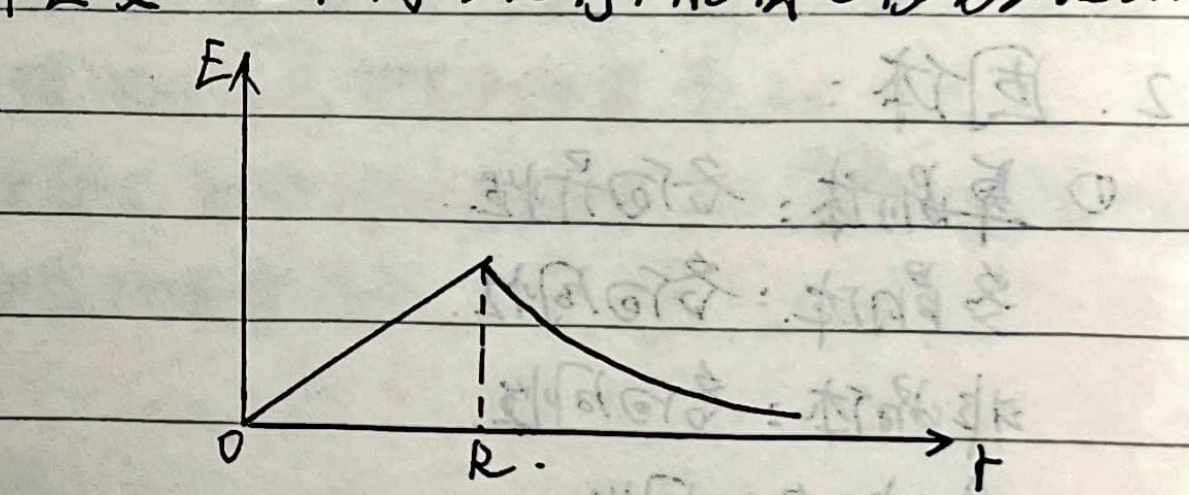
③ Electric field distribution of a hollow spherical shell (Thin conducting spherical shell or solid conducting sphere, charges distribute on the outer surface due to electrostatic equilibrium, charges can move freely):
$$ \begin{cases} \text{When } r < R, \quad E \cdot 4\pi r^2 = 0 \\ \quad \therefore E = 0 \\ \text{When } r \ge R, \quad E \cdot 4\pi r^2 = \frac{1}{\varepsilon_0} Q \\ \quad \therefore E = \frac{Q}{4\pi\varepsilon_0 r^2} \end{cases} $$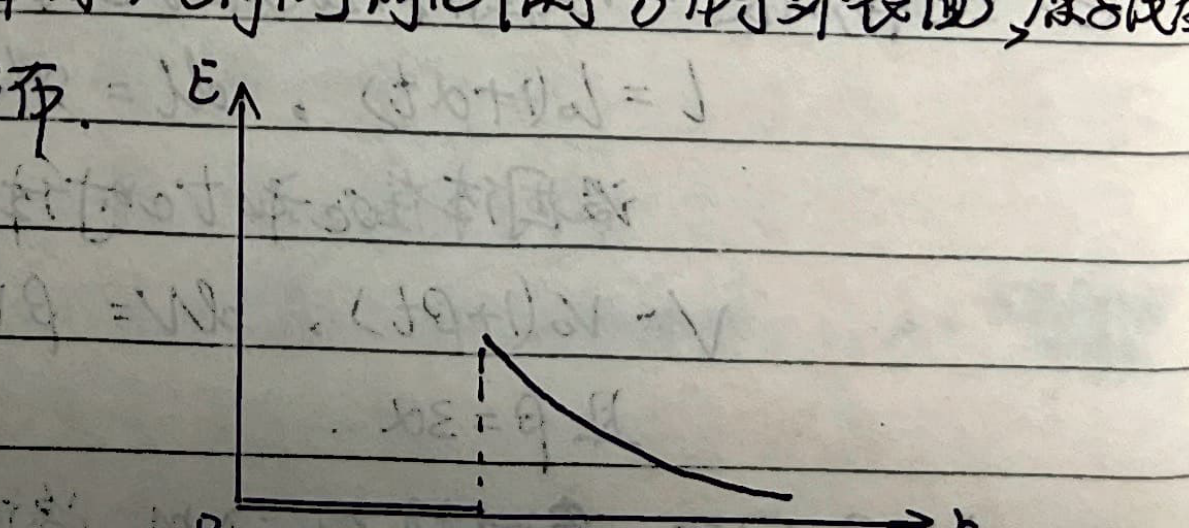
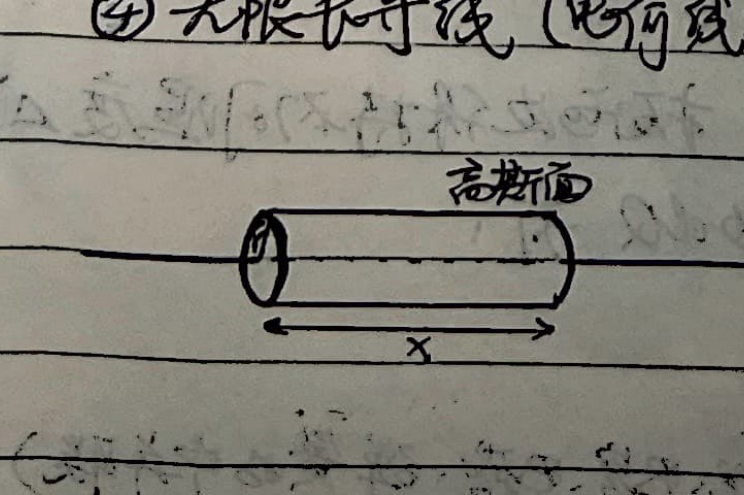
④ Electric field distribution of an infinitely long conducting wire (Charge linear density $\lambda$):
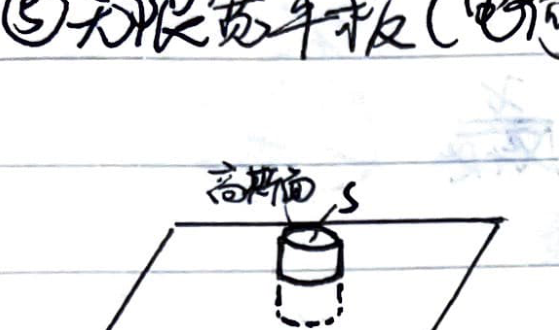
⑤ Electric field distribution of an infinitely wide flat plate (Charge surface density $\sigma$):
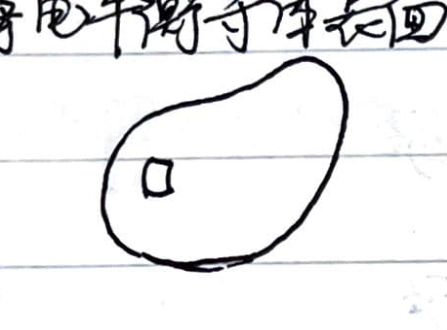
⑥ Surface of a conductor in electrostatic equilibrium:
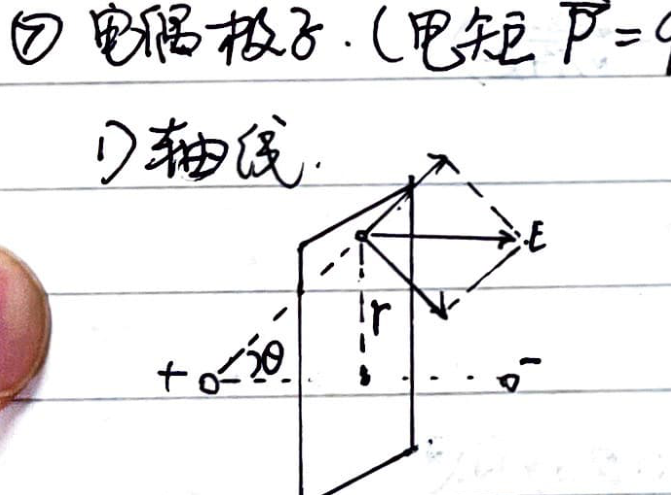
⑦ Electric Dipole: (Dipole moment $\vec{p} = q\vec{l}$, where $\vec{l}$ points from $-q$ to $+q$).
1) On the perpendicular bisector:
2) On the line connecting the charges:
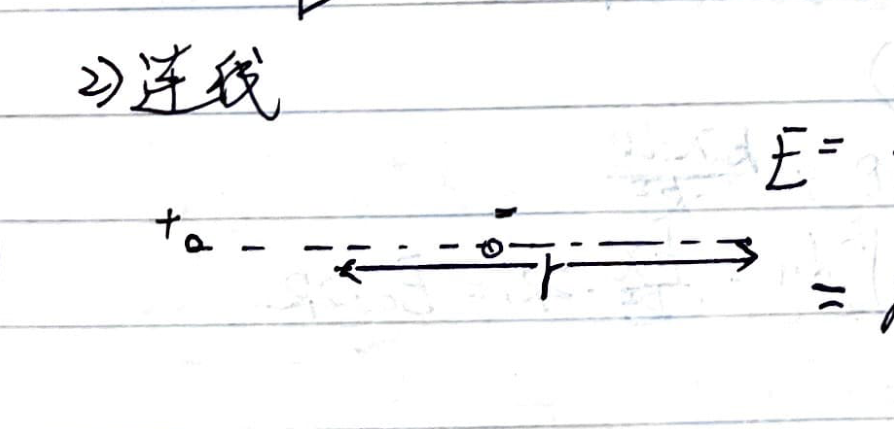 $$ E = \frac{kq}{(r - \frac{l}{2})^2} - \frac{kq}{(r + \frac{l}{2})^2} = kq \frac{r^2 + rl + \frac{l^2}{4} - r^2 + rl - \frac{l^2}{4}}{\left[r^2 - (\frac{l}{2})^2\right]^2} \approx kq \cdot \frac{2rl}{r^4} = \frac{2kql}{r^3} $$
$$ \therefore E \approx \frac{2kp}{r^3} $$
$$ E = \frac{kq}{(r - \frac{l}{2})^2} - \frac{kq}{(r + \frac{l}{2})^2} = kq \frac{r^2 + rl + \frac{l^2}{4} - r^2 + rl - \frac{l^2}{4}}{\left[r^2 - (\frac{l}{2})^2\right]^2} \approx kq \cdot \frac{2rl}{r^4} = \frac{2kql}{r^3} $$
$$ \therefore E \approx \frac{2kp}{r^3} $$
3) Arbitrary point:
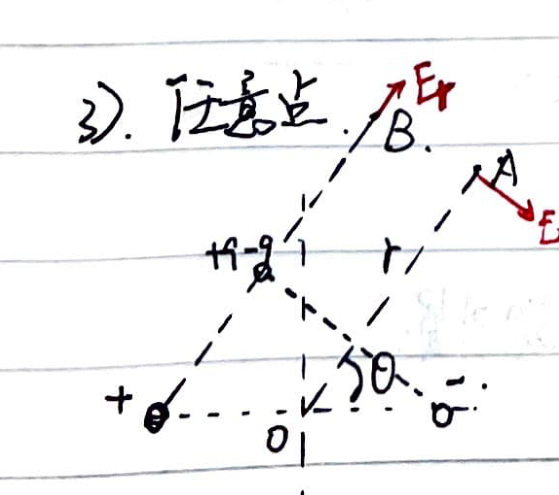
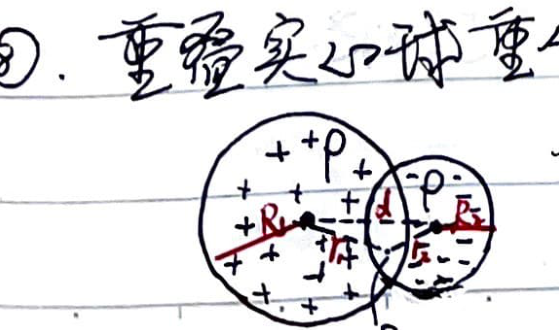
⑧ Electric field in the overlapping region of overlapping solid spheres (Volume density $\rho$ and $-\rho$):
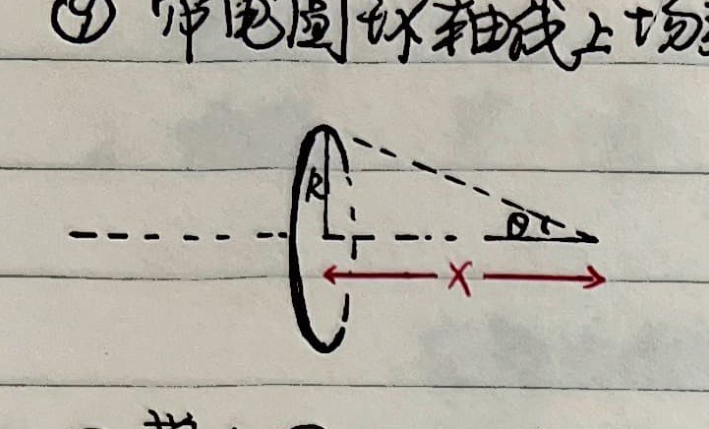
⑨ Electric field distribution on the axis of a charged ring:
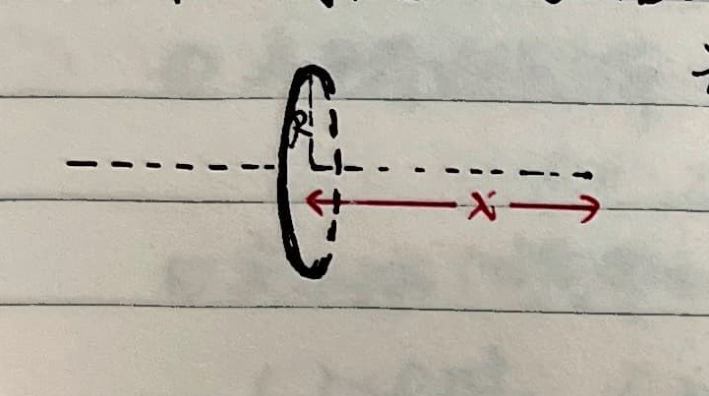
⑩ Electric field distribution on the axis of a charged disk:
Special Topic: Equivalent Methods for Finding Electric Field Strength
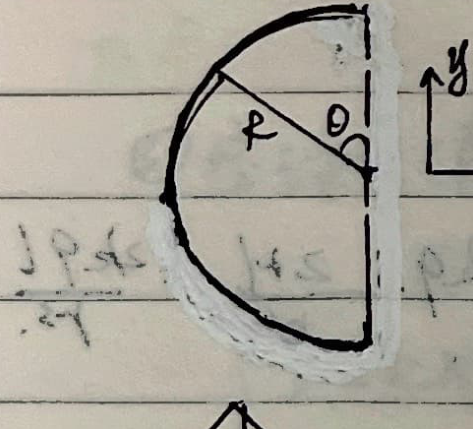
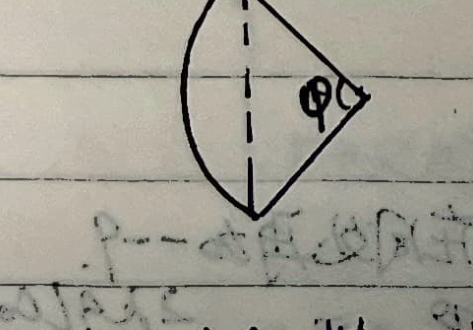
1. Generalizing from the electric field at the center of a uniformly charged semi-circle to an arc with subtended angle $\varphi$:
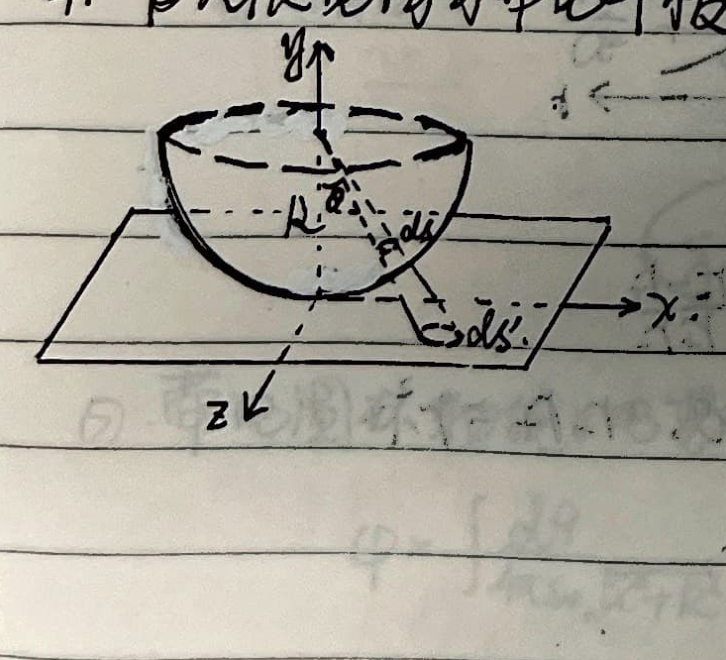
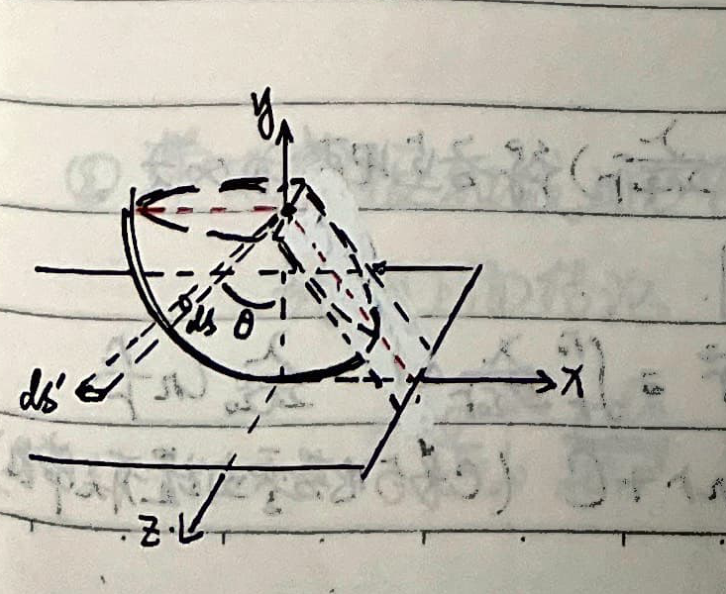
2. Generalizing from the electric field at the center of a uniformly charged hemispherical shell to a spherical cap with subtended angle $\varphi$:
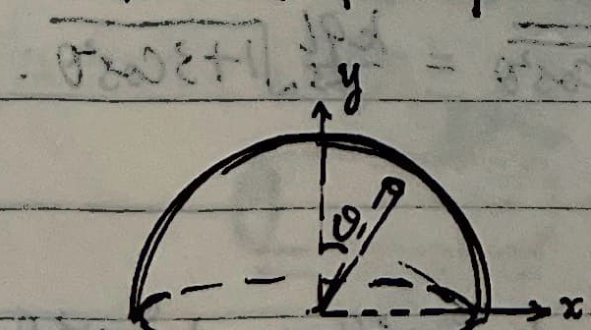
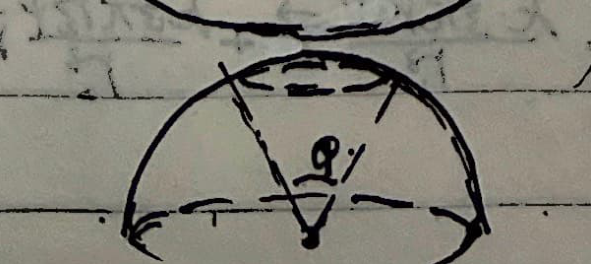
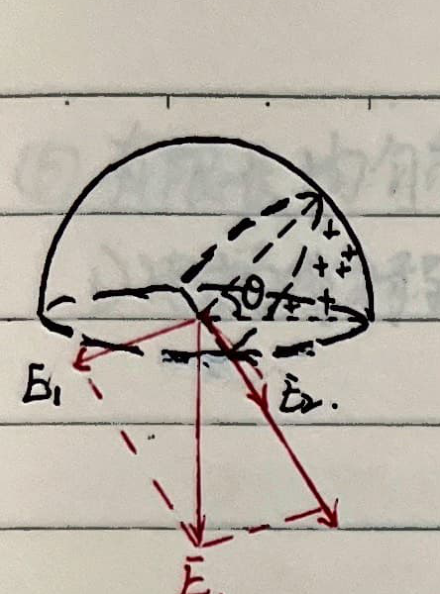
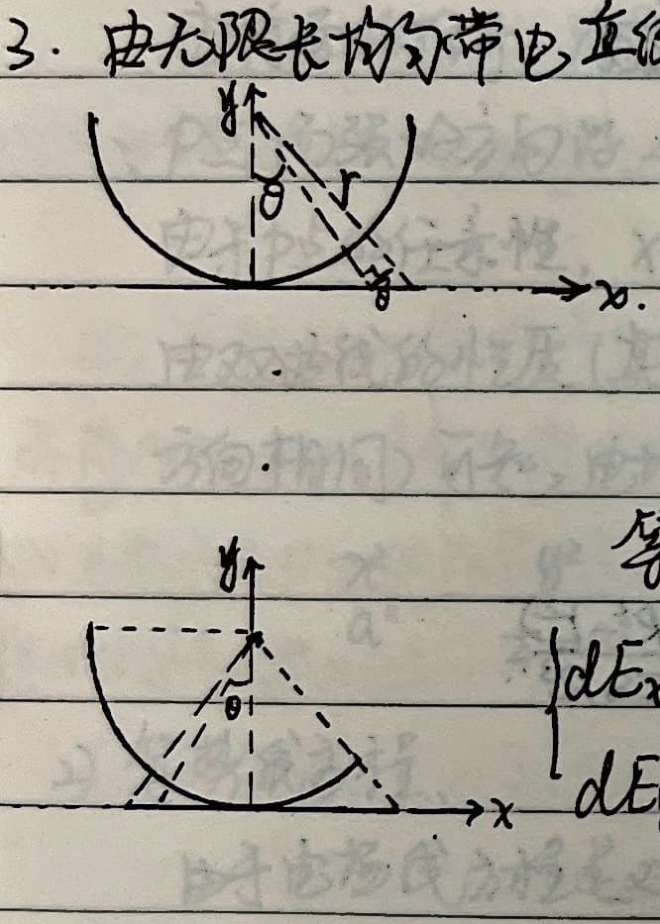
3. Generalizing from the electric field at distance R from an infinitely long uniformly charged line to a finite line:
4. Generalizing from the electric field at distance R from an infinitely wide uniformly charged plate to a finite plate:
3. Electric Potential
$$ \varphi_A = \int_A^\infty \vec{E} \cdot d\vec{l} $$ $$ \begin{cases} \varphi_A = \frac{1}{4\pi\varepsilon_0} \sum \frac{q_i}{r_i} \quad (\text{discrete}) \\ \varphi_A = \frac{1}{4\pi\varepsilon_0} \int \frac{dq}{r} \quad (\text{continuous}) \end{cases} $$When infinity is non-conducting, potential at infinity is zero. If not considering the charge of the Earth, Earth is regarded as potential zero.
① Electric potential distribution of a point charge:
$$ \varphi_a = \frac{q}{4\pi\varepsilon_0} \int_a^\infty \frac{dr}{r^2} = \frac{q}{4\pi\varepsilon_0} \left(-\frac{1}{r}\right)_a^\infty = \frac{q}{4\pi\varepsilon_0 a} $$ $$ U_{ab} = \varphi_a - \varphi_b = \frac{q}{4\pi\varepsilon_0}\left(\frac{1}{a} - \frac{1}{b}\right) $$② Solid sphere:
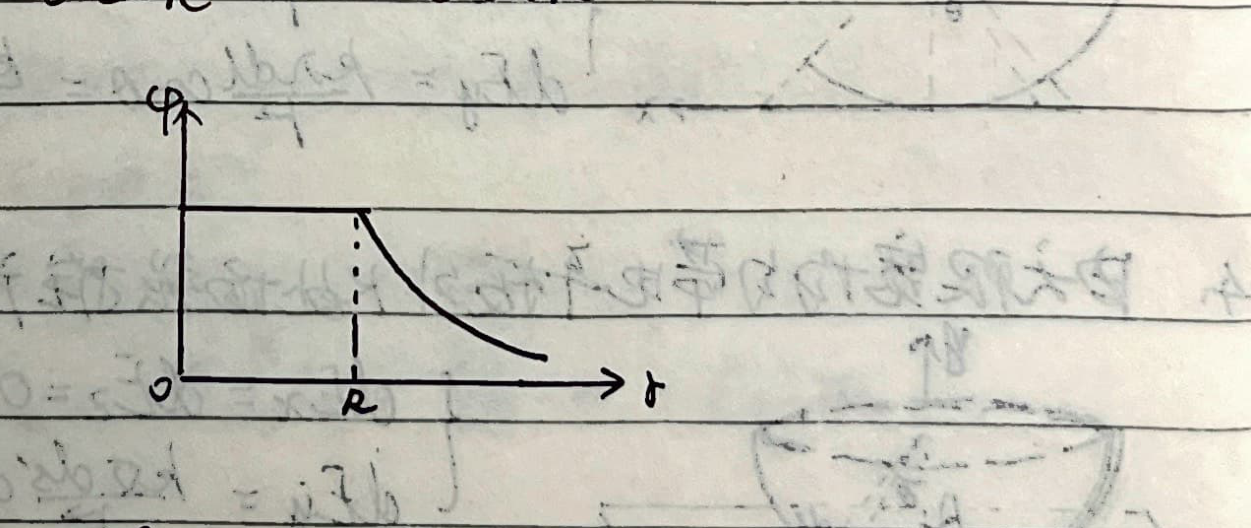
$$ \begin{cases} r \ge R, \quad \varphi = \int_r^\infty E dr = \frac{q}{4\pi\varepsilon_0 r} \\ r < R, \quad \varphi = \frac{q}{4\pi\varepsilon_0 R} + \int_r^R \frac{q \cdot r dr}{4\pi\varepsilon_0 R^3} = \frac{q}{4\pi\varepsilon_0 R} + \frac{q(R^2 - r^2)}{8\pi\varepsilon_0 R^3} = \frac{q(3R^2 - r^2)}{8\pi\varepsilon_0 R^3} \end{cases} $$③ Hollow spherical shell:
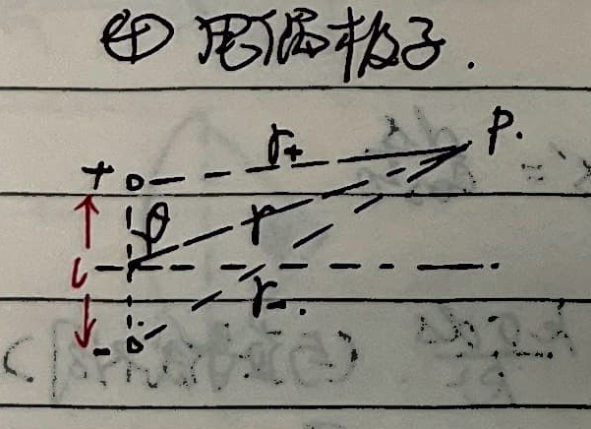
④ Electric Dipole:
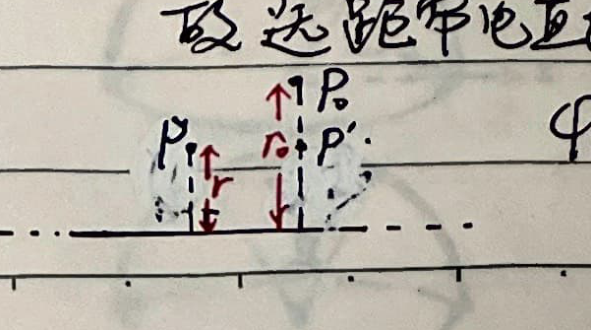
⑤ Electric potential distribution of infinitely long uniformly charged line:
⑥ Electric field lines and equipotential lines equations for a finite length uniformly charged straight line:
1) Electric field line equation:
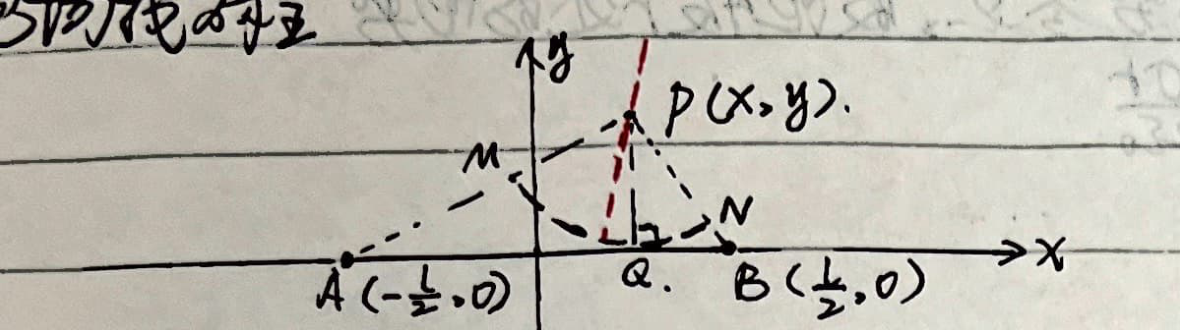
From the previous derivation, the effect of AB on P is equivalent to that of arc MN (with the same linear density $\lambda$) on P. $\therefore$ The direction of the electric field at point P is along the angle bisector of $\angle MPN$, which is also the tangent direction of the electric field line.
Due to the arbitrariness of point P, the direction of the electric field at any point on the $xy$ plane is along the bisector of $\angle APB$.
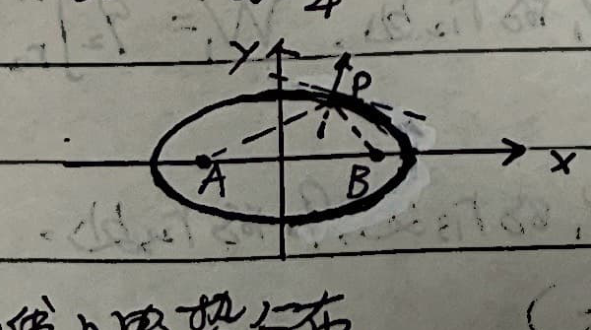
From the properties of a hyperbola (the tangent direction at any point on it is the same as the angle bisector of the lines connecting the two foci to that point), it can be known that the electric field lines are a family of confocal hyperbolas. Their equation is:
$$ \frac{x^2}{a^2} - \frac{y^2}{\frac{l^2}{4} - a^2} = 1 \quad \left(\text{where } 0 < a < \frac{l}{2}\right) $$2) Equipotential line equation:
⑦ Electric potential distribution on the axis of a charged ring:
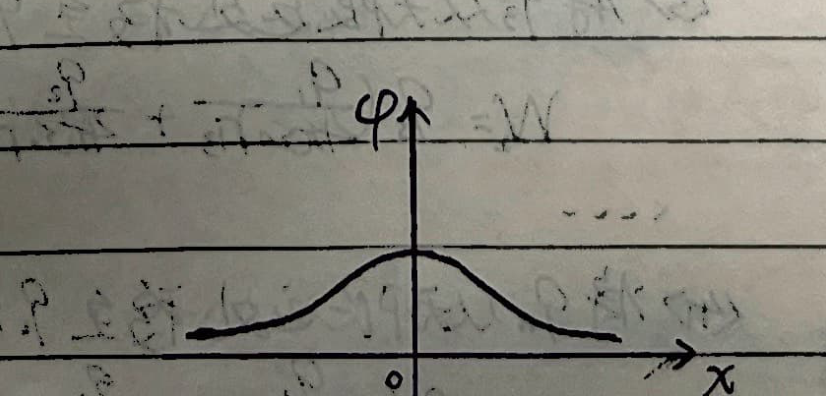
⑧ Electric potential distribution on the axis of a charged disk:
Using the above result:
$$ \varphi = \int \frac{dq}{4\pi\varepsilon_0\sqrt{x^2+r^2}} = \int_0^R \frac{2\pi r dr \sigma}{4\pi\varepsilon_0\sqrt{x^2+r^2}} $$ $$ = \frac{\sigma}{2\varepsilon_0} \int_0^R \frac{r dr}{\sqrt{x^2+r^2}} = \frac{\sigma}{4\varepsilon_0} \int_0^R \frac{d(x^2+r^2)}{\sqrt{x^2+r^2}} = \frac{\sigma}{2\varepsilon_0}\left(\sqrt{x^2+R^2} - x\right) $$⑨ Electric potential distribution of an infinitely wide uniformly charged flat plate:
Choosing the charged plane itself as the zero potential point, the potential at a distance $r$ from the plate is:
$$ \varphi = -\int_0^r \frac{\sigma}{2\varepsilon_0} dr = -\frac{\sigma r}{2\varepsilon_0} $$4. Electric Potential Energy and Electrostatic Energy
① Electric Potential Energy:
Because the electrostatic field is a conservative field, when moving a charge in an electrostatic field, the work done by the electrostatic field force is independent of the path. Therefore, any charge in an electrostatic field has electrostatic potential energy.
$$ W = q\varphi $$ $$ A_{12} = W_1 - W_2 = q(\varphi_1 - \varphi_2) $$The electric potential energy of a charge in an external electric field is shared by the charge and the charge system that produces the electric field. It is an interaction energy. Similarly, the electric potential energy of a point charge system in an external electric field is $W = \sum q_i \varphi_i$.
(Note: $\varphi_i$ does not include the potential produced by the charges within this charge system at that point.)
② Electrostatic Energy:
1) Mutual energy: The work done by electrostatic forces between charges when they are scattered from their current positions to infinity. i.e., the interaction energy of a point charge system.
- Moving $q_1$ from infinity to a point in space, no work is done.
- Moving $q_2$ from infinity to distance $r_{12}$ from $q_1$: $W_1 = q_2 \int_{r_{12}}^\infty \frac{q_1 dr}{4\pi\varepsilon_0 r^2} = \frac{q_1 q_2}{4\pi\varepsilon_0 r_{12}}$.
- Moving $q_3$ from infinity to distance $r_{13}$ from $q_1$ and $r_{23}$ from $q_2$: $W_2 = q_3 \left(\frac{q_1}{4\pi\varepsilon_0 r_{13}} + \frac{q_2}{4\pi\varepsilon_0 r_{23}}\right)$.
- $\dots$
- Moving $q_n$ from infinity to distance $r_{1n}$ from $q_1$ $\dots$ $r_{(n-1)n}$ from $q_{n-1}$: $W_n = q_n \left(\frac{q_1}{4\pi\varepsilon_0 r_{1n}} + \frac{q_2}{4\pi\varepsilon_0 r_{2n}} + \dots + \frac{q_{n-1}}{4\pi\varepsilon_0 r_{(n-1)n}}\right)$.
2) Self-energy: The work done by electrostatic forces when a charged body is divided into infinite charge elements and scattered to infinity from each other.
$$ E = \frac{1}{2} \int \varphi dq $$Therefore, the total electrostatic energy in space = mutual energy + self-energy = $\frac{1}{2} \int \varphi dq$.
$$ = \int w dV = \frac{1}{2} \varepsilon_0 \int E^2 dV \quad (w: \text{energy density}) $$③ Applications of Energy
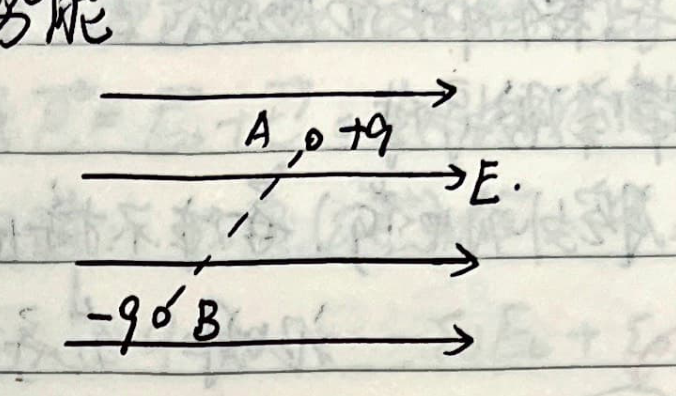
1) Electric potential energy of an electric dipole in an external uniform electric field $\vec{E}$:
2) Electrostatic energy of a parallel plate capacitor:
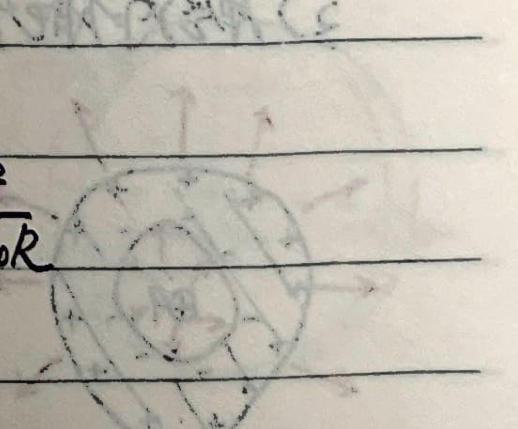
$$ \begin{cases} W = \frac{1}{2} \int \varphi dq = \frac{1}{2} q(U_1 - U_2) = \frac{1}{2} qU \\ W = \frac{1}{2}\varepsilon_0 \int E^2 dV = \frac{1}{2}\varepsilon_0 E^2 S \cdot d = \frac{1}{2}\varepsilon_0 \frac{U^2}{d^2} S \cdot d = \frac{1}{2} C U^2 \\ W = \int q dU = \int \frac{q dq}{C} = \frac{1}{2} \frac{q^2}{C} \end{cases} $$3) Solid sphere:
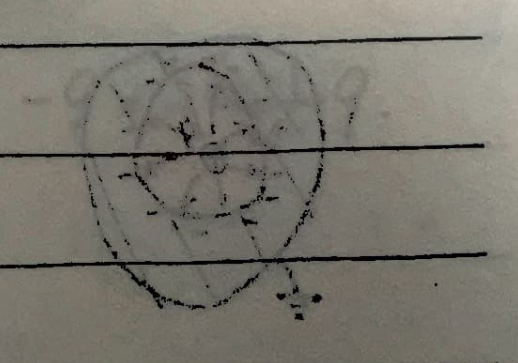
4) Hollow spherical shell:
5. Conductors and Dielectrics
① Conductors in electrostatic equilibrium:
$$ \begin{cases} \text{Inside: } \vec{E} = \vec{E}_{\text{external}} + \vec{E}_{\text{induced}} = 0 \\ \text{Outside: } \text{Field strength at outer surface } \vec{E} = \frac{\sigma}{\varepsilon_0} \vec{n} \perp \text{outer surface} \end{cases} $$The conductor is an equipotential body, its surface is an equipotential surface, and induced charges distribute on the surface.
Conductor with a cavity:
1) Charges outside cavity, conductor ungrounded, no charge on inner wall, no electric field inside cavity.
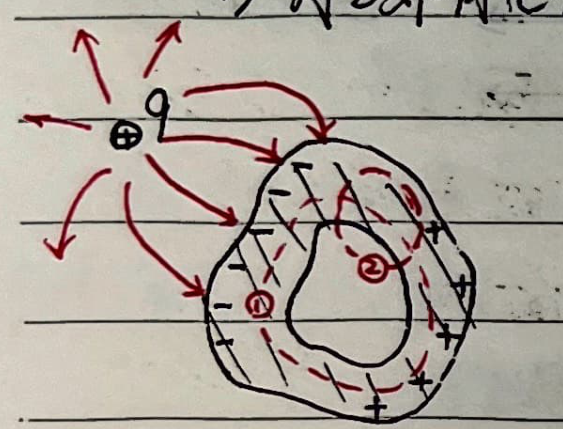
2) Charges outside cavity, conductor grounded, no charge on inner wall, only one type of charge on outer surface, no electric field inside cavity.
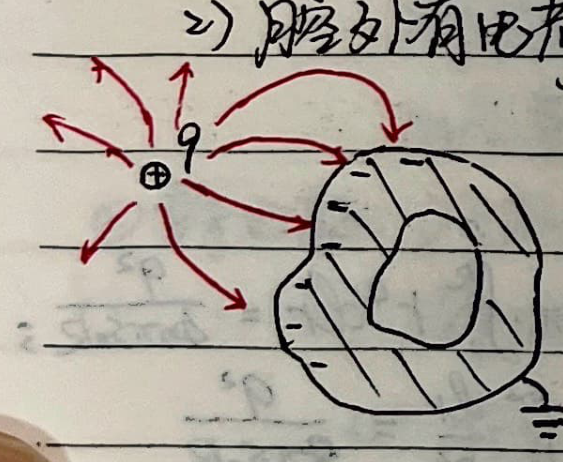
3) Charge inside cavity, conductor ungrounded, inner and outer wall charges are $-q$ and $+q$ respectively, electric field exists outside cavity.
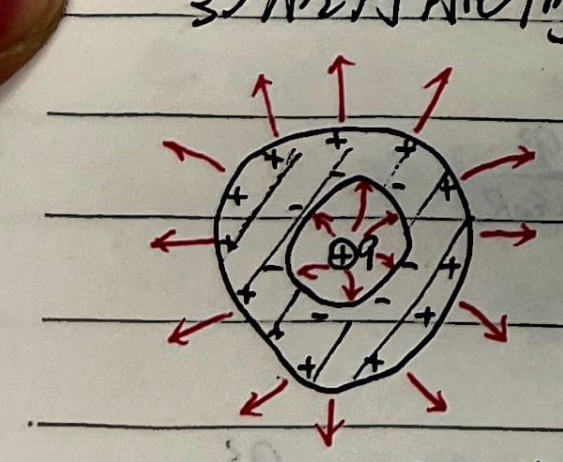
4) Charge inside cavity, conductor grounded, inner wall charge $-q$, outer wall charge $0$, no electric field outside cavity.
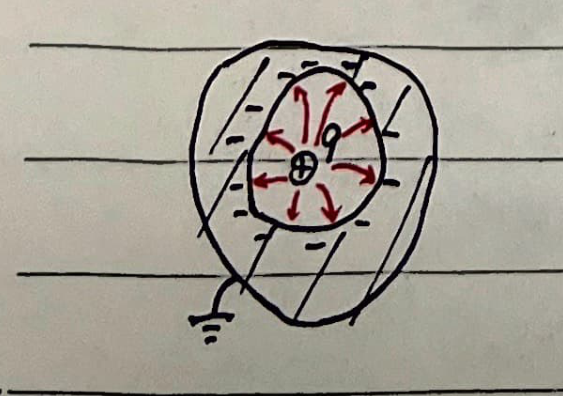
In summary: Cases 1) and 2): outside does not affect inside. Case 3): inside does not affect outside. If charges exist both inside and outside simultaneously (grounded or ungrounded), then superpose the respective cases.
② Dielectrics in electrostatic equilibrium:
$$ \begin{cases} \text{Polar molecules } \to \text{inherent electric moment } \to \text{inherent moments align in external field} \\ \text{Non-polar molecules } \to \text{induced electric moment } \to \text{external field separates centers of positive and negative charges} \end{cases} $$Macroscopic effect: generates surface polarization charges.
Let the external field be $\vec{E}_0$. The surface density of polarization charges is $\sigma'$. The field induced by it is $\vec{E}'$. The relative permittivity of the dielectric is $\varepsilon_r$. Therefore, the resultant field in space is $\vec{E} = \vec{E}_0 + \vec{E}'$.
Take a rectangular cuboid dielectric as an example:
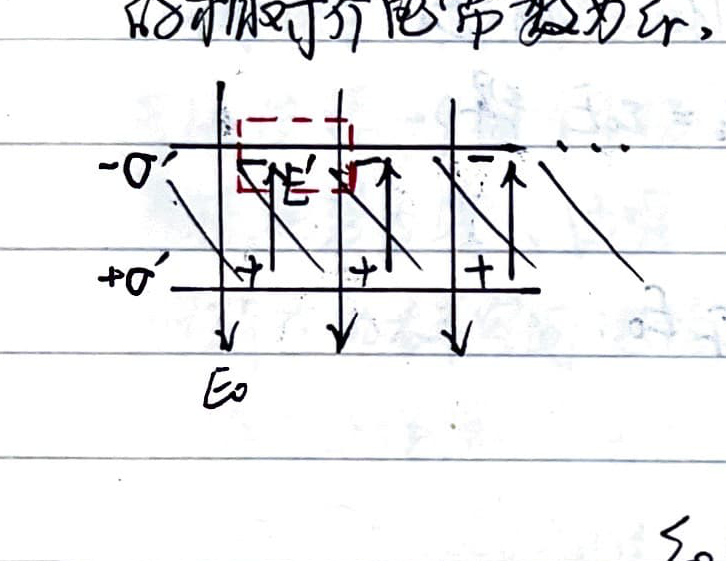
In summary: From initial conditions $E_0$ and $\varepsilon_r$, by Gauss's law:
$$ \begin{cases} \varepsilon_0 \oint_S \vec{E} \cdot d\vec{S} = q_{\text{free}} + q_{\text{polarization}} \\ \varepsilon_0 \oint_S (\varepsilon_r \vec{E}) \cdot d\vec{S} = q_{\text{free}} \end{cases} $$(Note: A dielectric is generally not an equipotential body, its surface is generally not an equipotential surface, and polarization charges distribute on the surface.)
We can solve for:
$$ E = \frac{E_0}{\varepsilon_r}, \quad E' = \frac{\varepsilon_r-1}{\varepsilon_r} E_0, \quad \sigma' = \frac{\varepsilon_0(\varepsilon_r-1)}{\varepsilon_r} E_0 $$Define polarization $\vec{P} = \varepsilon_0(\varepsilon_r-1)\vec{E}$, then $\sigma' = \frac{\vec{P} \cdot d\vec{S}}{dS} = \vec{P} \cdot \hat{n}$.
1) Sphere of radius R, charge q immersed in a dielectric $\varepsilon_r$:
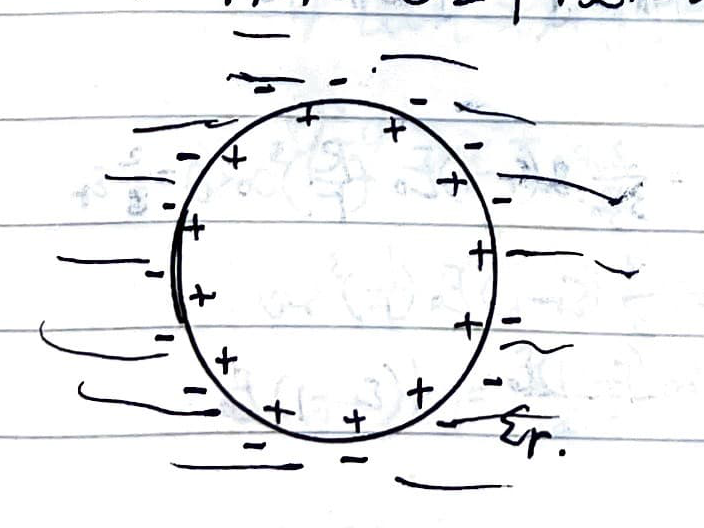
2) Half space between two parallel metal plates ($+\sigma_0, -\sigma_0$) is filled with dielectric $\varepsilon_r$. (See next page)
2) Half space between two parallel metal plates ($+\sigma_0, -\sigma_0$) is filled with dielectric $\varepsilon_r$.
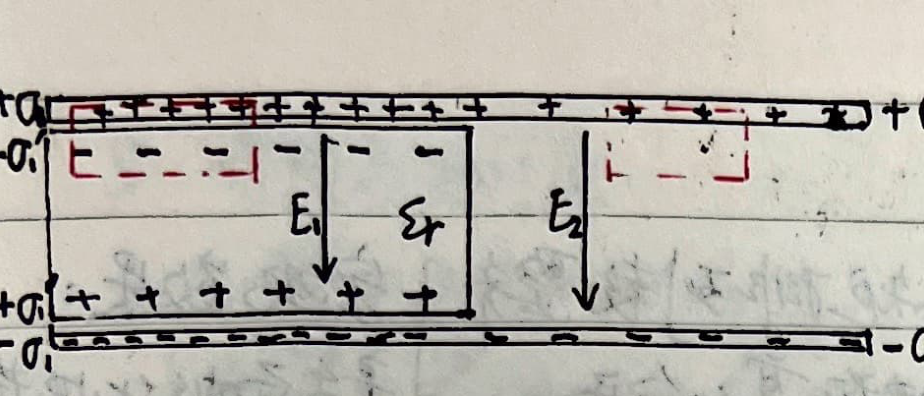
From charge conservation: $\sigma_1 + \sigma_2 = 2\sigma_0$.
From Gauss's law:
- In the dielectric: $(\sigma_1 \Delta S - \sigma_1' \Delta S) = \varepsilon_0 E_1 \Delta S \quad \therefore \sigma_1 - \sigma_1' = \varepsilon_0 E_1$.
- Alternatively: $\sigma_1 \Delta S = \varepsilon_0 \varepsilon_r E_1 \Delta S \quad \therefore \sigma_1 = \varepsilon_0 \varepsilon_r E_1$.
- In the vacuum: $\sigma_2 \Delta S = \varepsilon_0 E_2 \Delta S \quad \therefore \sigma_2 = \varepsilon_0 E_2$.
Also $\because U_1 = U_2 \quad \therefore E_1 = E_2$.
Thus from the equations we get:
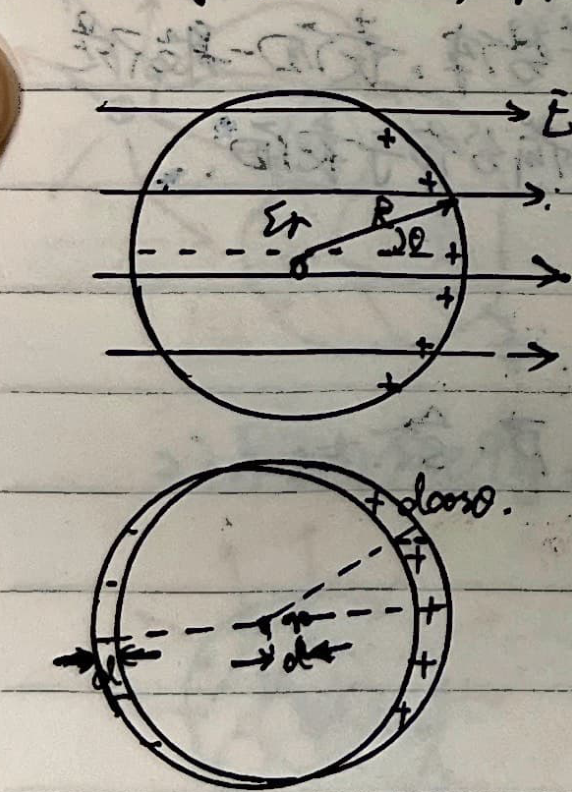
$$ \begin{cases} \sigma_1 = \frac{2\varepsilon_r}{1+\varepsilon_r} \sigma_0 \\ \sigma_2 = \frac{2}{1+\varepsilon_r} \sigma_0 \\ \sigma_1' = \frac{2(\varepsilon_r-1)}{1+\varepsilon_r} \sigma_0 \end{cases} \quad \text{and} \quad E_1 = E_2 = \frac{2\sigma_0}{\varepsilon_0(1+\varepsilon_r)} = \frac{2}{1+\varepsilon_r} E_0 $$3) Dielectric sphere of radius R, relative permittivity $\varepsilon_r$ in a uniform field $E_0$:
Special Topic: Method of Images
Principle: Replace the effect of induced charges with one or several point charges.
Essence: In the space where the original charges are located, the spatial electric field strength and potential distribution remain unchanged.
Reason: Uniqueness Theorem.
1. Infinite grounded flat plate:
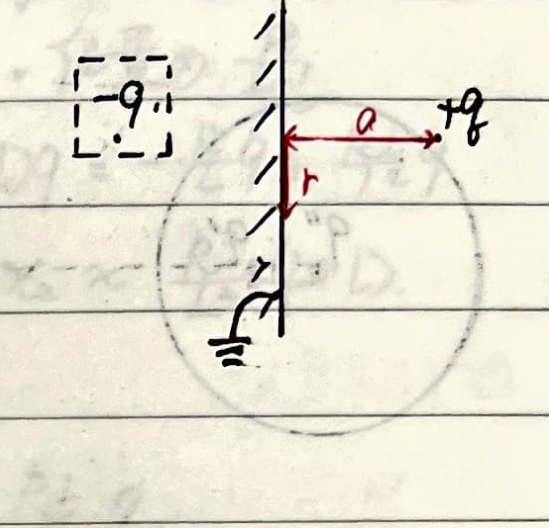
2. Grounded conducting spherical shell:
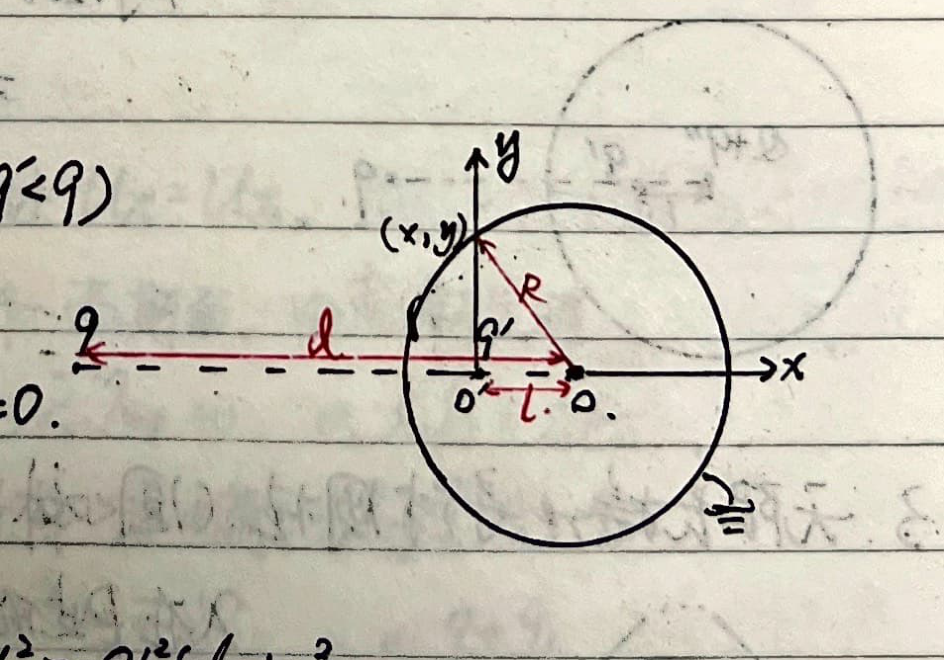
Also, since the potential at the center $O$ is $0$ in a grounded shell, $\frac{k q'}{l} + \frac{k q_{\text{induced}}}{R} = 0$, thus the total induced charge on the spherical surface equals the image charge $q'$.
Discussion:
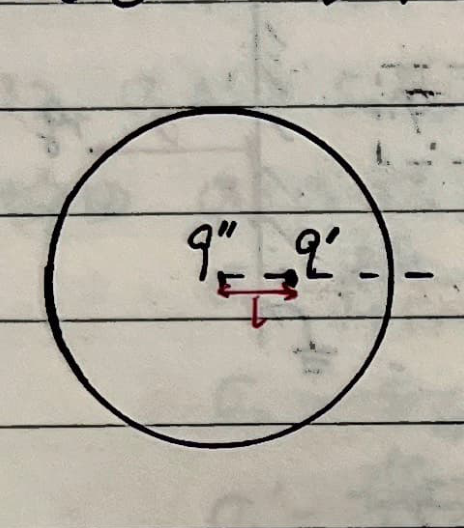
① If initially the spherical shell is ungrounded and uncharged, and $+q$ is placed outside:
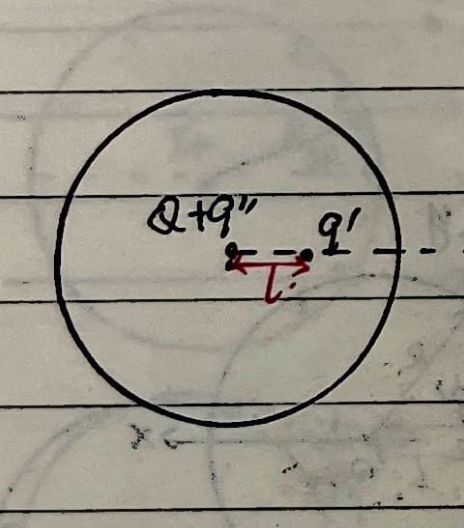
② If initially the shell is ungrounded and carries charge $Q$, and $+q$ is added outside:
3. Infinitely long grounded conducting cylinder (with line charge $\lambda$ at distance $d$ outside):
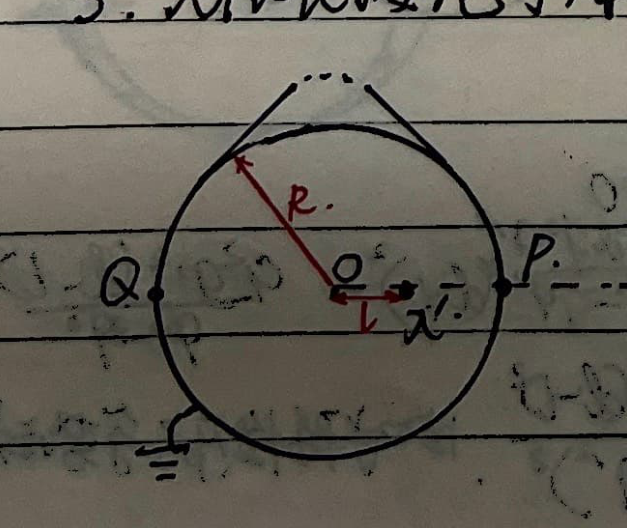
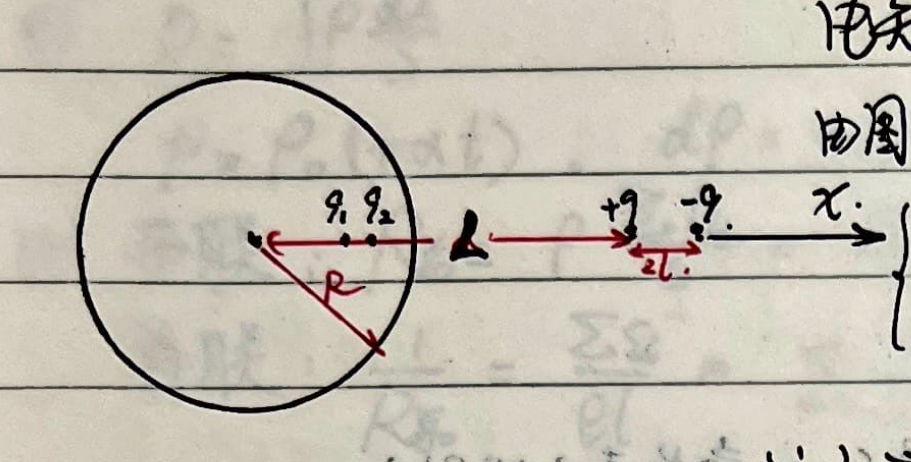
4. Electric dipole outside an ungrounded spherical shell at distance $L$:
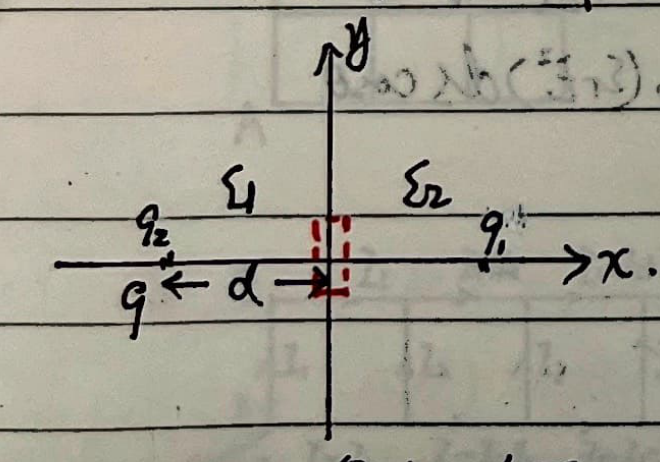
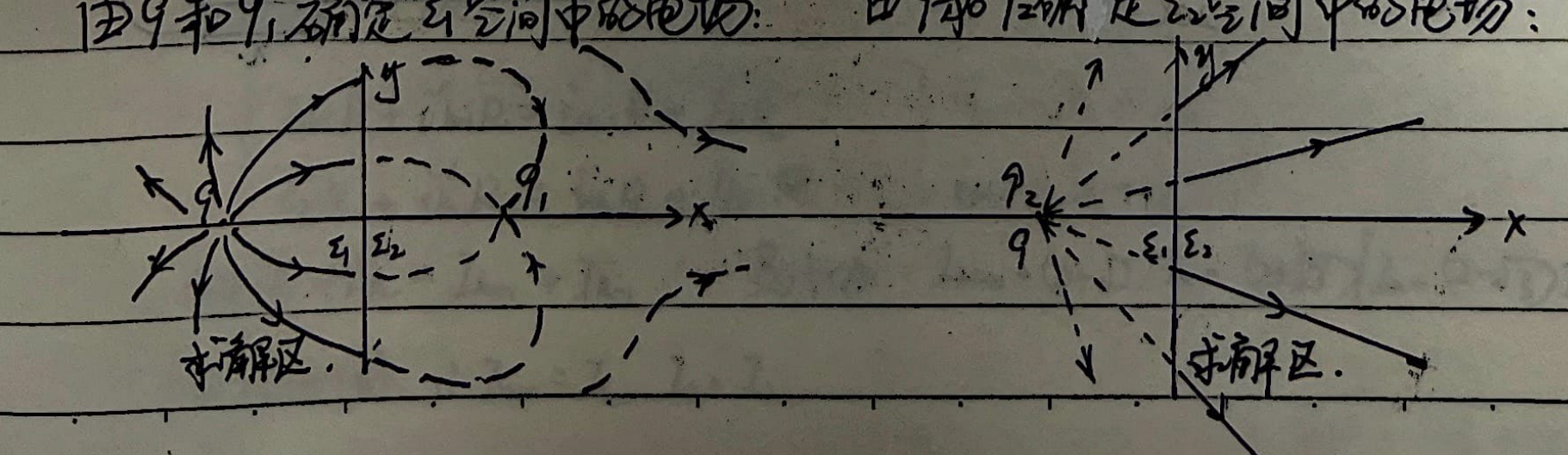
5. Image of a point charge with respect to an infinite dielectric plane:
Special Topic: Principle of Virtual Work in Electrostatic Fields
1. Electrostatic force experienced by the plates of a parallel plate capacitor:
① When $q$ is constant:
$$ W = \frac{1}{2}\varepsilon_0 E^2 S d = \frac{1}{2}\varepsilon_0 \left(\frac{q}{\varepsilon_0 S}\right)^2 S d = \frac{1}{2} \frac{q^2 d}{\varepsilon_0 S} $$ $$ \therefore F = -\frac{\partial W}{\partial d} = -\frac{q^2}{2\varepsilon_0 S} = -\frac{\sigma^2 S}{2\varepsilon_0} = -\frac{1}{2}\varepsilon_0 E^2 S $$The negative sign indicates an attractive force.
② When $U$ is constant:
$$ W = \frac{1}{2}\varepsilon_0 \left(\frac{U}{d}\right)^2 S d = \frac{1}{2} \frac{\varepsilon_0 U^2 S}{d} $$ $$ \therefore F = \frac{\partial W}{\partial d} = -\frac{\varepsilon_0 U^2 S}{2d^2} = -\frac{1}{2}\varepsilon_0 E^2 S $$The negative sign indicates an attractive force.
In summary, $|F| = \frac{1}{2}\varepsilon_0 E^2 S$, which can be generalized to any charged body. The electrostatic pressure is $f = \frac{dF}{dS} = \frac{1}{2}\varepsilon_0 E^2 = w_e$.
$$ F = \int_S p dS = \frac{1}{2\varepsilon_0} \int_S \sigma^2 dS. \quad \text{Also } W = \int_V \frac{1}{2}\varepsilon_0 E^2 dV $$ $$ F = \int_S \frac{1}{2}\varepsilon_0 (\varepsilon_r E^2) dS \cos\theta $$2. Interaction force between the upper and lower hemispheres of a charged conducting sphere:
$$ F = \frac{1}{2\varepsilon_0} \int_S \sigma^2 dS \cos\theta = \frac{\sigma^2}{2\varepsilon_0} \pi R^2 $$3. Force pulling a dielectric block inside parallel metal plates:
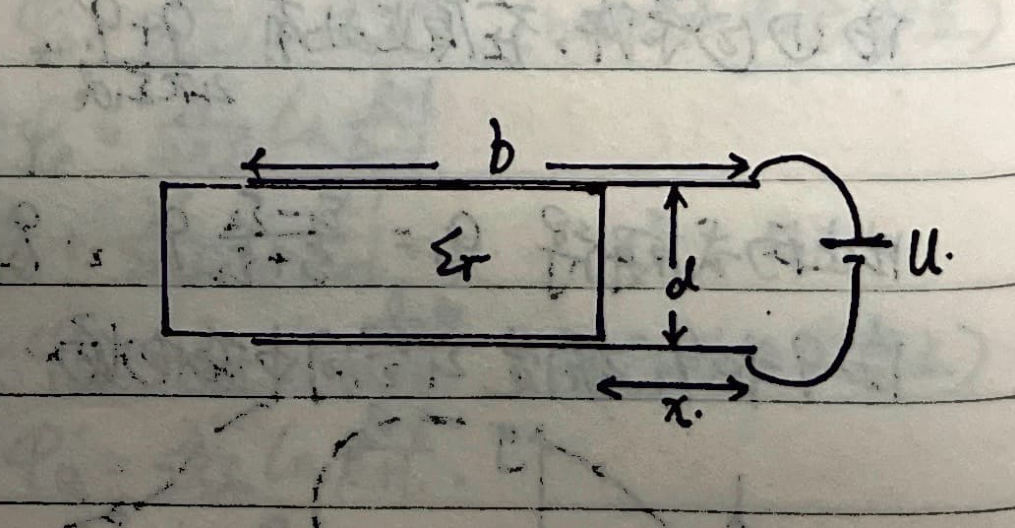
Special Topic: Model of Conductor Reaching Electrostatic Equilibrium

1. Decay of Current Density
Let the surface charge density accumulated on both ends of the conductor at time $t$ be $\sigma_e$. $\sigma_e$ generates an opposing electric field $E'$ inside the conductor, then $E = E_0 - E'$, which is the resultant field inside the conductor.
From Gauss's Law:
$$ -E_0 \Delta S + (E_0 - E') \Delta S = \frac{(-\sigma_e) \Delta S}{\varepsilon_0} $$ $$ \therefore E' = \frac{\sigma_e}{\varepsilon_0} $$Also, since $dq = i dt \implies d\sigma_e \cdot S = j \cdot S dt = \sigma E \cdot S dt$
$$ \therefore d\sigma_e = \sigma E dt = \sigma\left(E_0 - \frac{\sigma_e}{\varepsilon_0}\right) dt $$ $$ \therefore \int_0^{\sigma_e} \frac{d\sigma_e}{E_0 - \frac{\sigma_e}{\varepsilon_0}} = \int_0^t \sigma dt \implies \sigma_e = \varepsilon_0 E_0 (1 - e^{-\frac{\sigma}{\varepsilon_0} t}) $$And $E' = E_0 (1 - e^{-\frac{\sigma}{\varepsilon_0} t})$
Therefore, $E = E_0 e^{-\frac{\sigma}{\varepsilon_0} t}$
$$ j = \sigma E = \sigma E_0 e^{-\frac{\sigma}{\varepsilon_0} t} $$It can be seen that at $t=0$, $j = \sigma E_0$; as $t$ increases, $j$ decays exponentially; when $t \to \infty$, $j=0$, reaching electrostatic equilibrium.
2. Establishing a steady current:
In a conductor element, because $\vec{j} = \sigma \vec{E}$, $\oint \vec{E} \cdot d\vec{S} = \frac{q}{\varepsilon_0}$.
$$ \therefore \frac{1}{\sigma} \oint \vec{j} \cdot d\vec{S} = \frac{1}{\varepsilon_0} q $$From the continuity equation of current: $\oint \vec{j} \cdot d\vec{S} = -\frac{dq}{dt}$, we get
$$ -\frac{dq}{dt} = \frac{\sigma}{\varepsilon_0} q $$$\therefore$ The accumulated charge in the conductor element is $q = q_0 e^{-\frac{\sigma}{\varepsilon_0} t}$.