Part 6: Ideal Gas
1. Pressure:
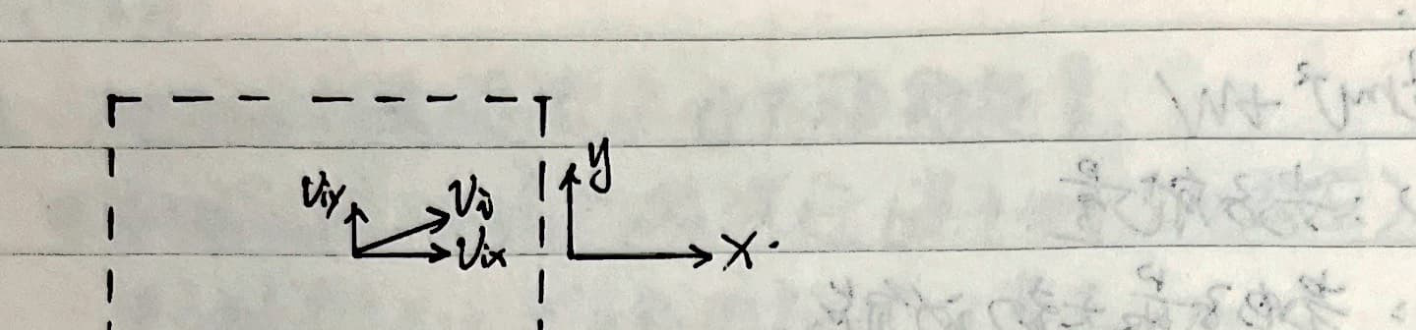 $$ p = \frac{\Delta F}{\Delta S} = \frac{\Sigma I_i}{\Delta S \Delta t} = \frac{\frac{1}{2}\Sigma (m \cdot n \cdot v_{ix} \Delta t \cdot \Delta S) \cdot 2v_{ix}}{\Delta S \cdot \Delta t} $$
In the above equation, $m(n v_{ix} \Delta t \Delta S)$ is the mass of the molecules in a cuboid hitting the container wall in time $\Delta t$.
$\frac{1}{2}$ represents that the probability of $v_{ix}$ in the $\pm x$ directions are both $\frac{1}{2}$. Since we only study the case of molecules hitting the right wall, we only take $\frac{1}{2}$.
$$ \therefore p = n m \frac{\Sigma v_{ix}^2 \cdot n_i}{n} $$ $$ \because \overline{v_x^2} = \frac{\Sigma v_{ix}^2 n_i}{n} = \frac{1}{3}\overline{v^2} $$ $$ \therefore P = \frac{1}{3} n m \overline{v^2} = \frac{2}{3} n \left(\frac{1}{2} m \overline{v^2}\right) $$2. Temperature:
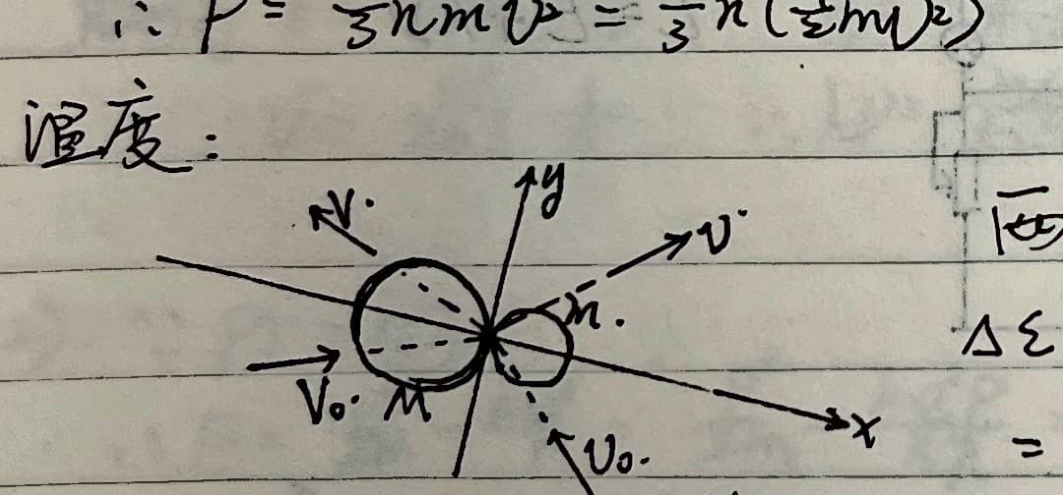
After two molecules undergo elastic collision, the kinetic energy lost by molecule $M$:
$$ \Delta E = \frac{1}{2}M(v_{ox}^2 - v_x^2) \quad (v_{oy} = v_y) $$ $$ = \frac{1}{2}M(v_{ox}-v_x)(v_{ox}+v_x) $$From conservation of momentum:
$$ v_x = \frac{M v_{ox} + m v_{ox}'}{M+m} - \frac{m(v_{ox}-v_{ox}')}{M+m} = \frac{(M-m)v_{ox} + 2m v_{ox}'}{M+m} $$ $$ \therefore v_{ox} - v_x = \frac{2m(v_{ox}-v_{ox}')}{M+m}, \quad v_{ox} + v_x = \frac{2M v_{ox} + 2m v_{ox}'}{M+m} $$ $$ \therefore \Delta E = \frac{2mM}{(M+m)^2} [M v_{ox}^2 - m v_{ox}'^2 - (M-m)v_{ox}' v_{ox}] $$Taking the average for a large number of molecules $M$, we get:
$$ \overline{\Delta E} = \frac{2mM}{(M+m)^2} [M \overline{v_{ox}^2} - m \overline{v_{ox}'^2} - (M-m)\overline{v_{ox}' v_{ox}}] $$ $$ \because \overline{v_{ox}} = \overline{v_{ox}'} = 0 \quad \therefore \overline{v_{ox}' v_{ox}} = 0 $$ $$ \therefore \overline{\Delta E} = \frac{2mM}{3(M+m)^2} (M \overline{v^2} - m \overline{v'^2}) \quad \left(\overline{v_x^2} = \frac{1}{3}\overline{v^2}\right) $$ $$ \propto \frac{1}{2}M\overline{v^2} - \frac{1}{2}m\overline{v'^2} $$From the zeroth law of thermodynamics, the average kinetic energy of molecules has the macroscopic characteristic of temperature, so we set:
$$ \frac{1}{2}m\overline{v^2} = B \cdot T $$3. Ideal Gas Equation of State:
From $P = \frac{2}{3}n\left(\frac{1}{2}m\overline{v^2}\right)$ and $BT = \frac{1}{2}m\overline{v^2}$, we have
$$ P = \frac{2}{3}nBT = \frac{2}{3}\frac{N}{V}BT = \frac{2}{3}\frac{\nu N_A}{V}BT \quad (n: \text{number density}, \nu: \text{moles}) $$ $$ \therefore PV = \frac{2}{3}\nu N_A BT $$Let $R = \frac{2}{3}N_A B$, we get:
$$ PV = \nu RT. \quad \therefore T = \frac{1}{B}\left(\frac{1}{2}m\overline{v^2}\right) = \frac{2N_A}{3R}\left(\frac{1}{2}m\overline{v^2}\right). $$Deduction: $PV = \frac{M}{\mu}RT = \frac{\rho V}{\mu}RT$, $\therefore \mu P = \rho RT$.
For the same gas: $\frac{P_1 V_1}{T_1} = \frac{P_2 V_2}{T_2}, \quad \frac{P_1}{\rho_1 T_1} = \frac{P_2}{\rho_2 T_2}$.
For all gases in the same system: $\frac{P_{\text{total}} V_{\text{total}}}{T_{\text{total}}} = R \sum \nu_i = \sum \frac{P_i V_i}{T_i}$.
4. First Law of Thermodynamics Applied to Ideal Gas
($\nu$: number of moles)
① Thermodynamic processes: The process of the system state changing with time (state variables: $P, T, V$).
$$ \begin{cases} \text{Quasi-static: } \text{every intermediate state is approximately an equilibrium state.} \\ \text{Non-quasi-static: } \text{intermediate states cannot be considered equilibrium states (cannot be represented on a P-V diagram).} \end{cases} $$1) Work: $dW = F dl = PS dl = P dV$.
2) Heat: $dQ = \nu C dT \quad (C: \text{molar heat capacity. For solids } C \text{ is constant. For gases } C \text{ can vary})$.
3) Internal energy: $dU = \frac{i}{2}\nu R dT$ (Molecular thermal motion: translation, rotation, vibration + potential energy between atoms in molecule).
$i = t + r + 2s \quad (t: \text{translational degrees of freedom} = 3; r: \text{rotational degrees of freedom} = 2, 1, 0; s: \text{vibrational degrees of freedom} = 3N-6)$.
For monoatomic molecules: $U = N \cdot \left(\frac{1}{2}m\overline{v^2}\right) = N \cdot \frac{3}{2}BT = \frac{3}{2}\nu RT$.
First Law of Thermodynamics: $U_0 + Q - W = U_t, \quad dQ = dU + dW$.
(Heat absorbed $Q$ is positive, work done by system on surroundings $W$ is positive).
② Analysis of various processes: $dQ = P dV + \frac{i}{2} \nu R dT, \quad PV = \nu RT$.
1) Isochoric process: $P = \frac{\nu R}{V} \cdot T$.
$$ \begin{cases} \text{Work done by system on surroundings: } W = \int P dV = 0. \\ \text{Change in system internal energy: } \Delta U = \frac{i}{2} \nu R \Delta T. \\ \text{Heat absorbed by system from surroundings: } Q = \frac{i}{2} \nu R \Delta T = \nu C_V \Delta T. \end{cases} $$2) Isobaric process: $V = \frac{\nu R}{P} \cdot T$.
$$ \begin{cases} \text{Work done by system on surroundings: } W = \int P dV = P \Delta V = \nu R \Delta T. \\ \text{Change in system internal energy: } \Delta U = \frac{i}{2} \nu R \Delta T = \nu C_V \Delta T. \\ \text{Heat absorbed by system from surroundings: } Q = \nu(C_V+R)\Delta T = \nu C_P \Delta T. \end{cases} $$3) Isothermal process: $P = \frac{\nu RT}{V}$.
$$ \begin{cases} \text{Work done by system on surroundings: } W = \int_{V_1}^{V_2} P dV = \nu RT \int_{V_1}^{V_2} \frac{dV}{V} = \nu RT \ln\frac{V_2}{V_1} = -\nu RT \ln\frac{P_2}{P_1}. \\ \text{Change in system internal energy: } \Delta U = \frac{i}{2} \nu R \Delta T = 0. \\ \text{Heat absorbed by system from surroundings: } Q = \nu RT \ln\frac{V_2}{V_1}. \end{cases} $$4) Adiabatic process: $PV^\gamma = P_0 V_0^\gamma$.
From $P dV + V dP = \nu R dT$ and $\nu C_V dT + P dV = dU + dW = 0$, we get:
$$ \frac{C_V}{R} (P dV + V dP) + P dV = 0 \implies \frac{R+C_V}{C_V} \frac{dV}{V} = -\frac{dP}{P}. $$Integrating gives $\ln\frac{V}{V_0} = -\frac{C_V}{C_P} \ln\frac{P}{P_0} \dots \implies PV^{\frac{C_P}{C_V}} = P_0 V_0^{\frac{C_P}{C_V}} \implies PV^\gamma = P_0 V_0^\gamma$.
$$ \begin{cases} \text{Work done by system: } W = \int_{V_1}^{V_2} P dV = \int_{V_1}^{V_2} \frac{P_0 V_0^\gamma}{V^\gamma} dV = \left. P_0 V_0^\gamma \frac{1}{1-\gamma} V^{1-\gamma} \right|_{V_1}^{V_2} \\ \quad = -\frac{C_V}{R} P_0 V_0^\gamma (V_2^{-\frac{R}{C_V}} - V_1^{-\frac{R}{C_V}}) = \dots \\ \quad = \frac{C_V}{R} (P_1 V_1 - P_2 V_2) = \frac{C_V}{R} (\nu R T_1 - \nu R T_2) = \nu C_V (T_1 - T_2). \\ \text{Internal energy change: } \Delta U = \nu C_V (T_2 - T_1) = \nu C_V \Delta T. \\ \text{Heat absorbed: } Q = 0. \end{cases} $$5) Carnot cycle of ideal gas:
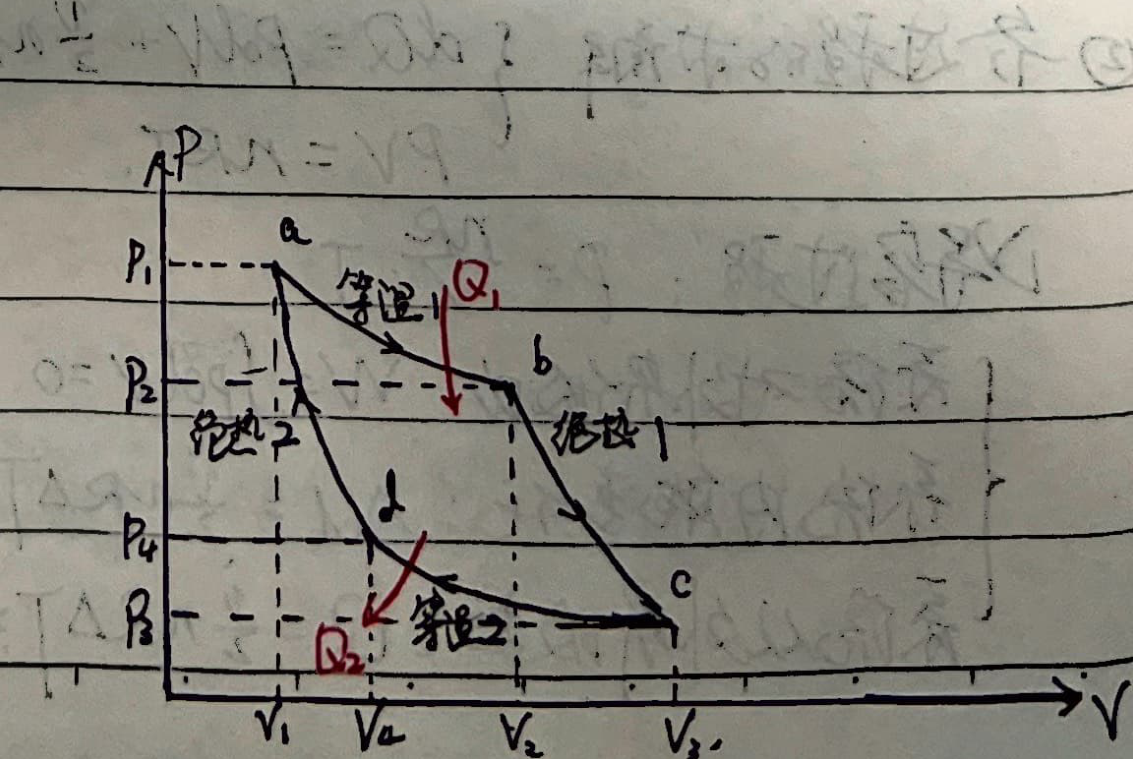
(1) $Q_1 = \nu R T_1 \ln\frac{V_b}{V_a}$: Isothermal expansion $ab$ absorbs heat $Q_1$ from high temp source $T_1$.
(2) $T_1 V_b^{\gamma-1} = T_2 V_c^{\gamma-1}$: Adiabatic process $bc$.
(3) $Q_2 = \nu R T_2 \ln\frac{V_c}{V_d}$: Isothermal compression $cd$ releases heat $Q_2$ to low temp source $T_2$.
(4) $T_2 V_d^{\gamma-1} = T_1 V_a^{\gamma-1}$: Adiabatic process $da$.
From (2) and (4) we get: $\frac{V_b}{V_a} = \frac{V_c}{V_d}$. Substituting into (3) yields:
$$ Q_2 = \nu R T_2 \ln\frac{V_b}{V_a} $$Comparing with (1) we get: $\frac{Q_1}{T_1} = \frac{Q_2}{T_2}$
$$ \therefore \eta = \frac{A}{Q_1} = \frac{Q_1 - Q_2}{Q_1} = 1 - \frac{T_2}{T_1}. $$5. Saturated and Unsaturated Vapor
($n_{\text{evap}} = n_{\text{cond}}$ vs $n_{\text{evap}} > n_{\text{cond}}$)
Properties:
- At the same temperature, the saturated vapor pressures of different liquids are generally different.
- The saturated vapor pressure of a given liquid increases rapidly with temperature. Thus, when the volume of saturated vapor decreases or the temperature drops, the vapor will liquefy.
- The condition for liquid boiling is that the saturated vapor pressure of the liquid at that temperature equals the external pressure.
Calculation: According to Dalton's law of partial pressures: gas pressure in a closed container $P = P_{\text{gas}} + P_{\text{vapor}}$.
When there is liquid water in the container and it's in an equilibrium state, $P_{\text{vapor}} = P_{\text{sat}}$, which corresponds to 100% relative humidity.
For a mixture of air and water vapor, when the vapor is unsaturated, it approximately follows the ideal gas equation of state, i.e., $P_{\text{gas}} V = \nu_{\text{gas}} R T$, $P_{\text{vapor}} V = \nu_{\text{vapor}} R T$, and $PV = \nu_{\text{total}}RT$.
When temperature drops, water vapor turns into saturated vapor; if temperature drops further or pressure increases, water vapor will partially liquefy. At this time $P_{\text{sat}} V' = \nu_{\text{vapor}}' R T$, and $P_{\text{gas}}' V' = \nu_{\text{gas}} R T$.
For a mixture of air and water vapor, if there is no liquid water present, it can be calculated using the ideal gas equation of state.
$$ \rho = \frac{M_{\text{gas}} \cdot \nu_{\text{gas}} + M_{\text{vapor}} \cdot \nu_{\text{vapor}}}{V} \quad (M_{\text{gas}} = 28.8 \text{ g/mol}, M_{\text{vapor}} = 18 \text{ g/mol}). $$And definitions: Absolute humidity = $P_{\text{vapor}}$, Relative humidity = $\frac{P_{\text{vapor}}}{P_{\text{sat}}}$ (where $P_{\text{sat}}$ is the saturated vapor pressure at that temperature).
Part 7: Liquids and Solids
1. Surface Tension of Liquids
$$ F = \sigma L \quad (\text{Direction: normal to the drawn line, tangent to the liquid surface}) $$Property: For a non-planar liquid surface, surface tension will cause a pressure difference between inside and outside. As shown in the figure:
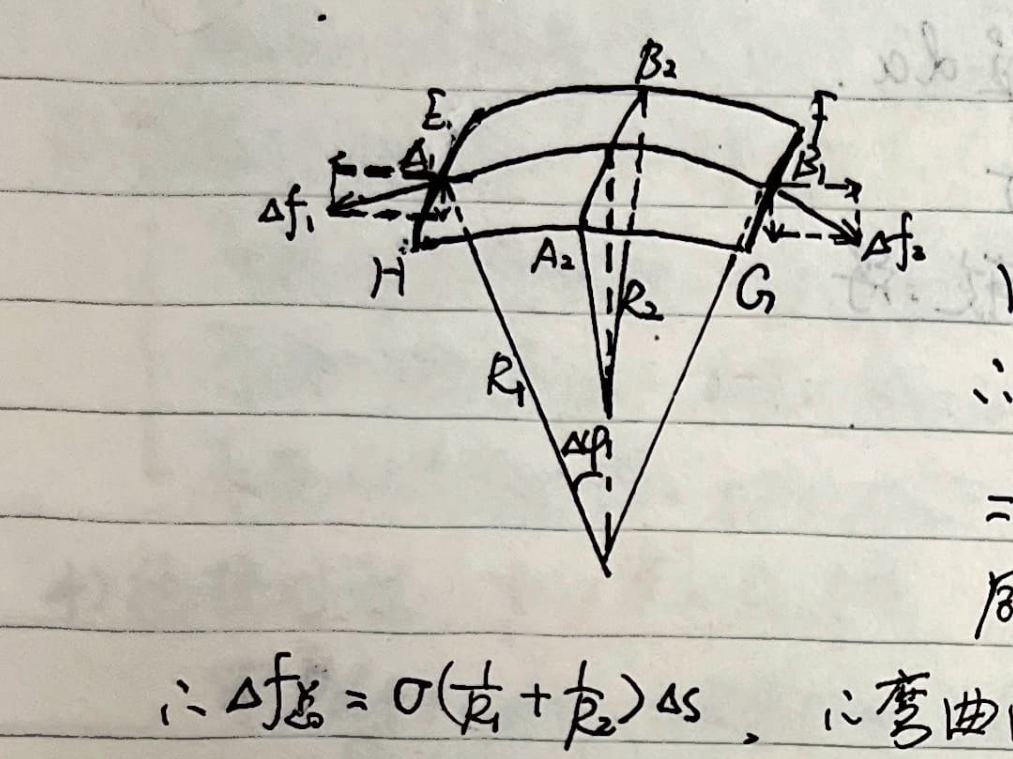
Let $\widehat{AB} = \widehat{EF} = \widehat{HG} = \Delta l_1$, $\widehat{A_1B_1} = \widehat{HE} = \widehat{GF} = \Delta l_2$.
Because the horizontal components of $\Delta f_1$ and $\Delta f_2$ cancel each other,
$$ \therefore \text{The combined effect of } \Delta f_1 \text{ and } \Delta f_2 \text{ is } (\Delta f_1 + \Delta f_2)\Delta\varphi = 2\sigma \Delta l_2 \Delta\varphi = 2\sigma \Delta l_2 \cdot \frac{A_1B_1}{2R_1} = \frac{\sigma}{R_1} \Delta l_1 \Delta l_2 = \frac{\sigma}{R_1} \Delta S. $$Similarly, for $\widehat{A_2B_2}$ there is a combined force $\frac{\sigma}{R_2}\Delta S$.
$$ \therefore \Delta f_{\text{total}} = \sigma\left(\frac{1}{R_1} + \frac{1}{R_2}\right)\Delta S $$$\therefore$ The pressure difference caused by the curved surface is $p = \frac{\Delta f_{\text{total}}}{\Delta S} = \sigma\left(\frac{1}{R_1} + \frac{1}{R_2}\right)$.
Where $R_1, R_2$ are the principal radii of curvature of two mutually perpendicular normal sections.
$$ \begin{cases} \text{For a spherical surface, additional pressure } p_1 = \frac{2\sigma}{R} \\ \text{For a spherical bubble film, additional pressure } p_2 = 2p_1 = \frac{4\sigma}{R} \end{cases} $$① Capillary Phenomenon
For a wetting liquid:
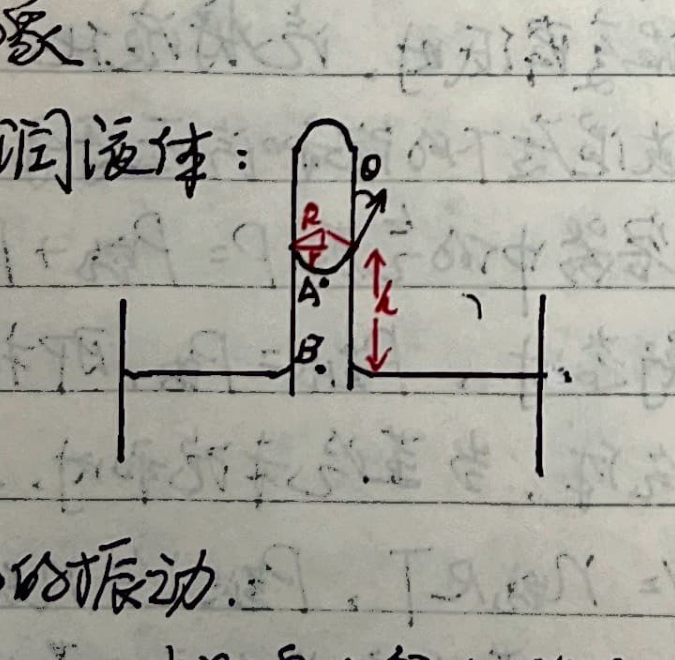 $$ \because p_A = p_0 - \frac{2\sigma}{R}. $$
$$ p_B = p_A + \rho g h = p_0. $$
$$ \therefore h = \frac{2\sigma}{\rho g R}. \quad \text{Also } \because R\cos\theta = r, \quad \therefore h = \frac{2\sigma\cos\theta}{\rho g r}. $$
$$ \because p_A = p_0 - \frac{2\sigma}{R}. $$
$$ p_B = p_A + \rho g h = p_0. $$
$$ \therefore h = \frac{2\sigma}{\rho g R}. \quad \text{Also } \because R\cos\theta = r, \quad \therefore h = \frac{2\sigma\cos\theta}{\rho g r}. $$
② Vibration of a Soap Bubble
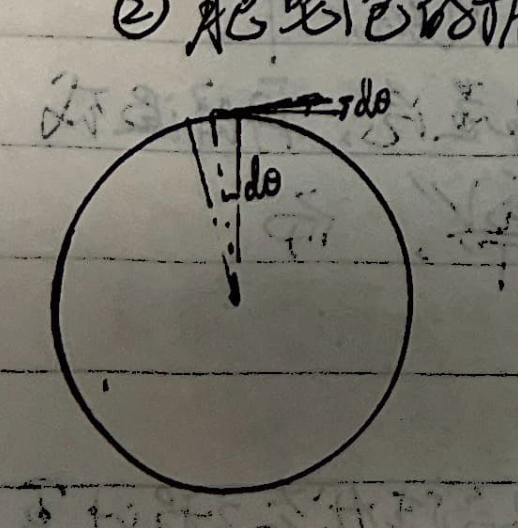
When the soap bubble radius expands by $x$, the surface has:
$$ df_{\text{total}} = P_0 ds + \frac{4\sigma}{R+x} ds - p' ds \quad (P_0 \text{ is atmospheric pressure}). $$At equilibrium, $P_0 ds + \frac{4\sigma}{R} ds = P ds$. $\therefore P = P_0 + \frac{4\sigma}{R}$.
Due to isothermal change, $\therefore P \cdot \frac{4}{3}\pi R^3 = P' \cdot \frac{4}{3}\pi (R+x)^3$. $\therefore P' = \left(\frac{R}{R+x}\right)^3 \cdot \left(P_0 + \frac{4\sigma}{R}\right)$.
$$ \therefore df_{\text{total}} = P_0\left[1 - \left(\frac{R}{R+x}\right)^3\right] ds + 4\sigma\left[\frac{1}{R+x} - \frac{R^2}{(R+x)^3}\right] ds $$ $$ \approx P_0\left[1 - \frac{R^3}{R^3+3R^2x}\right] ds + 4\sigma\left[\frac{1}{R+x} - \frac{R^2}{R^3+3R^2x}\right] ds $$ $$ \approx P_0\left(1 - \frac{R-3x}{R}\right) ds + 4\sigma\left(\frac{R-x}{R^2} - \frac{R-3x}{R^2}\right) ds $$ $$ = \frac{3x}{R}P_0 ds + \frac{2x}{R^2} 4\sigma ds. $$ $$ \therefore dk = \frac{3P_0 ds}{R} + \frac{8\sigma ds}{R^2}. $$ $$ \therefore T = 2\pi \sqrt{\frac{dm}{dk}} = 2\pi \sqrt{\frac{\frac{ds}{4\pi R^2} m}{\left(\frac{3P_0}{R} + \frac{8\sigma}{R^2}\right) ds}} = 2\pi \sqrt{\frac{m}{12\pi R P_0 + 32\pi \sigma}}. $$The work done by surface tension during this process:
$$ W = \int_{R_1}^{R_2} \frac{4\sigma}{R} \cdot 4\pi R^2 \cdot dR = 16\pi\sigma \int_{R_1}^{R_2} R dR = 8\pi\sigma(R_2^2 - R_1^2). $$Similarly, calculating with surface free energy:
$$ W = (2\sigma)(S_2 - S_1) = 2\sigma(4\pi R_2^2 - 4\pi R_1^2) = 8\pi\sigma(R_2^2 - R_1^2) $$(Because a liquid film has two surfaces, each surface doing work $\sigma\Delta S$, two surfaces doing work to overcome surface tension is $2\sigma\Delta S$).
Special Topic: Boiling Conditions
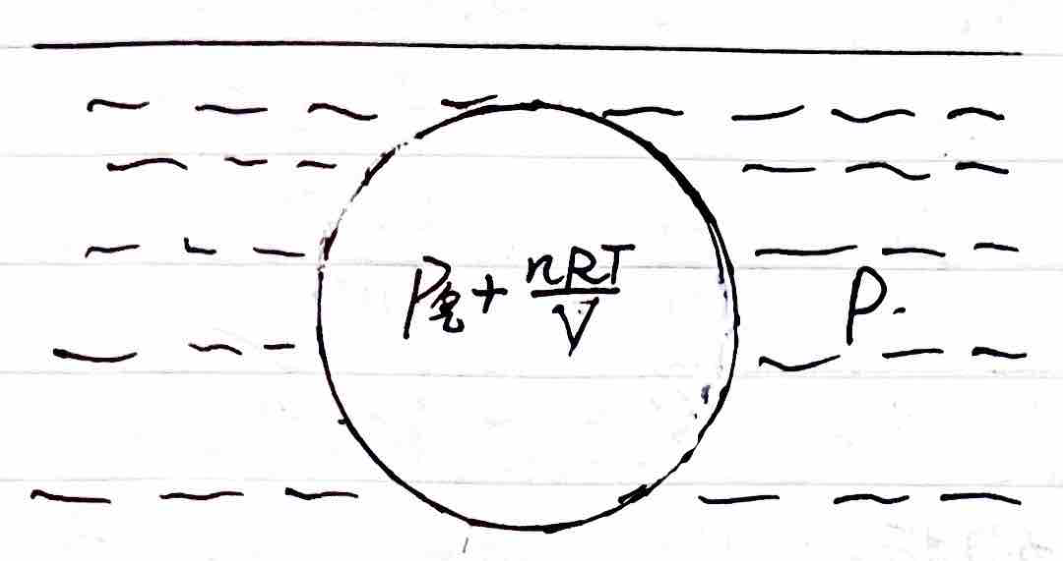
The gas inside the bubble consists of saturated vapor and dry air. The pressure outside the bubble is generated jointly by the liquid and the atmosphere.
Let the saturated vapor pressure be $P_{\text{sat}}$ and the dry air pressure be $\frac{nRT}{V}$.
The pressure inside the bubble is the sum of the liquid's saturated vapor pressure and the air pressure: $\frac{nRT}{V} + P_{\text{sat}}$.
Let the pressure outside the bubble be $P$, and assume the bubble radius is not too small.
$$ \therefore P_{\text{sat}} + \frac{nRT}{V} - P = \frac{2\sigma}{r} \approx 0 $$When the temperature rises, $P_{\text{sat}}$ increases; at this time, the bubble volume increases, causing $\frac{nRT}{V}$ to decrease. The bubble can reach a new equilibrium.
When $P_{\text{sat}}$ increases to equal $P$, no matter how much the volume increases, equilibrium cannot be maintained, and boiling occurs.
Therefore, when $P_{\text{sat}} = P$, i.e., the temperature at which the saturated vapor pressure of the liquid inside the bubble equals the external pressure, is the boiling point.
If in a closed container, the total pressure above the liquid surface (liquid saturated vapor pressure + other gas pressures) is consistently greater than the liquid's saturated vapor pressure, the liquid in the container cannot boil.
2. Solids:
① Crystal Types:
- Single crystal: Anisotropy.
- Polycrystal: Isotropy.
- Amorphous solid: Isotropy.
- Liquid: Isotropy.
- Liquid crystal: Anisotropy.
② Thermal Expansion:
Let the length of a solid at $0^\circ\text{C}$ and $t^\circ\text{C}$ be $l_0$ and $l$. We have:
$$ l = l_0(1 + \alpha t), \quad dl = \alpha l_0 dt. $$Let the volume of a solid at $0^\circ\text{C}$ and $t^\circ\text{C}$ be $V_0$ and $V$. We have:
$$ V = V_0(1 + \beta t), \quad dV = \beta V_0 dt. $$And $\beta = 3\alpha$.
③ Phase Changes:
For the same solid: heat of fusion $Q_1 = \lambda m$; heat of vaporization $Q_2 = L m$.
Heat of sublimation $Q_3 = Q_1 + Q_2 = (\lambda + L)m$.
④ Heat Conduction:
Let there be a plate of cross-sectional area $S$ and thickness $x$. The two sides of the plate maintain a temperature difference $\Delta T$.
The heat $dQ$ flowing perpendicular to the plate surface in time $dt$ is:
$$ H = \frac{dQ}{dt} = -k S \cdot \frac{\Delta T}{x} $$ $$ \begin{cases} \text{Multi-layer plates in series: } H = \frac{-S\Delta T}{\sum (x_i/k_i)} \\ \text{Multi-layer plates in parallel: } H = -\frac{\Delta T}{x} \sum (k_i S_i) \end{cases} \quad \text{(Similar to the series and parallel connections of resistors, capacitors, inductors, and springs)}. $$Special Topic: High School Physics Experiments (Thermodynamics & Molecular Physics)
Experiment 10: Use Oil Film Method to Estimate the Size of a Molecule
Experiment Objective: Estimate the diameter of (oleic acid) molecules.
Equipment: Oleic acid, alcohol, shallow tray, talcum powder, graduated cylinder (two), dropper (or syringe), glass plate, pen, coordinate paper.
Principle: Oleic acid molecules form a monomolecular layer on the water surface. By calculating the area of the film formed by a certain known volume of pure oleic acid on the water, we can calculate the size (diameter) of the oleic acid molecule.
Procedure:
- Prepare an oleic acid-alcohol solution of a certain known concentration $C$.
- Pour water into the shallow tray and sprinkle talcum powder evenly on it.
- Use a dropper or syringe to drop the oleic acid-alcohol solution into the graduated cylinder. Make the volume $1\text{ mL}$. If $n$ drops correspond to $1\text{ mL}$, the volume of each drop is $V_0 = \frac{1}{n} \text{ mL}$.
- Drop exactly one drop (of volume $V_0$) of the solution onto the water surface. The oleic acid will quickly spread out to form a monomolecular film, while the alcohol will evaporate or dissolve.
- After the shape of the oil film stabilizes, place a glass plate over the shallow tray and use a pen to carefully trace the shape of the oil film onto the glass.
- Place the glass plate on coordinate paper to estimate the area $S$ of the oil film. (Method for counting grid squares: discard any portion less than half a square, and count any portion greater than half a square as one full square).
- Based on the initial concentration $C$ of the solution, calculate the volume of pure oleic acid in one drop: $V_{\text{pure}} = V_0 \times C$.
The film thickness (molecular diameter) is then:
$$ D = \frac{V_{\text{pure}}}{S} $$(The calculated order of magnitude for the molecular diameter should be around $10^{-10}\text{ m}$).